Behold The 60Hz Ultra Jag!

There are three types of gamer in this world. There are the ones who just play games they enjoy, and don't really give a toss about stuff like borders and speed and PAL, NTSC and all the other guff that you can get wrapped up in. Then there are the others who like nothing more than discussing the intricacies of an RGB output or the slight differences in frame-rate between one version of a game and another. Then there are people like me who sort of straddle the two. Sure - I play import games occasionally and I do sometimes dabble with a soldering iron and tinker with the innards of various systems...but to be totally honest, I can take or leave all that stuff. As far as I'm concerned, if a game can be played - I'll play it.

This probably stems from just having PAL systems as a kid and not really having the means to investigate the 'superior' 60Hz stuff from exotic places like Japan and America. I had what I was given, and I was happy to play it. Ignorant? You bet. Did I have much of a choice? Nope! Anyway, what I'm trying to say is that the whole 'PAL stuff is crap' thing never really bothered me, and to my untrained eyes, the difference between 50Hz and 60Hz is something I'm just not arsed about.

Recently however, my learned friend and co-writer here at Do The Math (we'll call him 'Andrew') told me that via the medium of arcane magic (also known as electronics) he could add a switch to a Jaguar console that would enable me to effortlessly move hither and thither between the plain old 50Hz I'm accustomed to; and the spangly 60Hz usually reserved for the rich, famous, politically motivated and bourgeois. So I sent one of my cats - that's how I affectionately refer to my Jaguars - off to Andrew in the far, treacherous and leper-ridden North; and nary a week later it was back with me in the South, smelling strongly of coal dust...but with an additional switch festooned upon it's side:
This little nubbin allows me to switch between 50Hz and 60Hz signals. It can't be done 'on the fly' like some other mods I've seen recently (you have to turn the system off before hand) but this isn't really an issue for me. The extra calories burned by moving my hand 30cm from the switch to the on/off button and back again are negligible. Andrew also kindly supplied me with some pictures of the modification process being undertaken:
This is all very good, I'm sure you'll agree. But what about the actual differences this type of modification makes to the operation of the games themselves? Well, I have to be honest here - I wasn't really expecting to see much of a difference because I had been informed that a lot of Jaguar games were programmed by European software houses and as such are optimised for the 50Hz console. And, for a lot of the games I have tried...I have to confirm that this is indeed the case. There are a couple of things that are instantly noticeable though, regardless of the game you're playing - the visible screen is noticeably bigger in 60Hz mode and the boot sequence does run slightly faster...but for the most part with a lot of carts, this is the only real difference. However, this isn't the case with every game. Oh no.

Certain games are improved to the point that the increased speed makes them feel like totally different experiences. Games like Doom and Wolfenstein are examples of this, and Doom in particular moves so much more smoothly than the 50Hz version that it's actually quite stunning. Super Burnout too, feels a little quicker...if that's actually possible. There doesn't seem to be any particular rule at play here - some games benefit massively from the switch to 60Hz, while others (rather disappointingly) do not. One game that I thought might be sped up by the change is AvP...but alas the only difference on display is the increased real estate on the screen. This is probably more to do with the actual game engine than the frequency of the console, but I was hoping for more. That said, this is a really interesting subject and below is a selection of screen shots from various games that illustrate the increased play area if nothing else.
60Hz Vs 50Hz Doom
60Hz Pitfall
50Hz Pitfall
60Hz Boot
50Hz Boot
60Hz AvP
50Hz AvP
All in all, I'm really impressed with the modification that Andrew performed and I pretty much exclusively use the 60Hz Jag now just because of the increased screen size on my TV. It's an operation that's well worth investigating and if you're interested in having this done yourself, drop us a message in the comments section and we'll get you sorted.

Jaguar The Musical

I was browsing the internet t'other day and one of those random adverts popped up in the sidebar of a website. Don't know what I'd been looking at for Google to target Cats the Musical at me...but it did. As I glanced at the advert, I noticed an alarming similarity between it and the logo of another 'thing' involving felines...


Or maybe my affection for the Jaguar has gone just a little bit too far.

Guest Article: Steve Mitchell (Lore Design) Interview

Lore Design was the company responsible for the production of Highlander: The Last Of The McLeods on the Jaguar CD. Released in October 1995 the game was an impressive Alone In The Dark style 3D adventure that used motion-captured characters along side 24-bit true colour backdrops. It was based on the Gaumont Multimedia animated TV series, that was in turn based on the film starring Christopher Lambert. A further two games were planned but never released. Here, freelance games journalist Kieren Hawken interviews Steve Mitchell, the owner of Lore Design and producer on all three Highlander games.


What are the origins of Lore Design in the video game industry?

The company was founded to do the Computer Moderated Play By Mail game Lore Lords of Britain, which ran for most of the life of the business. Whilst in a gap year I did the BBC Micro ports of the James Bond game License to Kill and Atari arcade game Return Of The Jedi for Domark with my college friend Chris Lowe.

Around the time I graduated I completed Kung Food for the Atari Lynx with Paul Johnson, Tim Harper and Christian Urquhart (who is famous for being employed by Ocean Software in the 80s while still at school). Working with Christian taught me a lot about gameplay and Paul was an inspired artist who could script whole games himself and proved to be a good at business too.

Can you tell us a little bit about how Highlander came about?

Atari licensed the Highlander animated series for a Jaguar CD game. They picked Lore to develop it as we had completed several Lynx games and Dave Worton, who worked with me on some of them, had started working with 3D Studio on a pre-rendered Z buffered backdrop that allowed for the limited polygon characters that were needed for the Jaguar system and the Alone in The Dark style perspective that Atari had picked for the game. Atari also paid for state of the art motion capture studio to be built at our development studio. They paid for all the original voice actors to be flown over and provided footage from the cartoon series for us to use. Sadly this was the last game completed by Lore as a dispute with the then Atari Corp on future titles resulted in the insolvency and ultimately the voluntary receivership of the business in around 1997.


It has long been rumoured that both Highlander II and III were completed, what can you tell us about the sequels?

There was a PC version of Highlander and the sequels were in production but unreleased, as they were licensed games and those licenses had expired. I can't imagine there being any official versions released however. But it is not impossible that either from QA (testing), Atari or an ex-Lore member that something may be out there. So I can't squash the rumour, though I'd be very surprised if it was a final version.

What was the Jaguar like to work with?

Personally I much preferred the Lynx over the Jaguar for development. Generally cartridge consoles had not only RAM but also ROM to work from directly. Adding the CD meant reads had to be cached into your RAM instead of just sitting in the ROM making the CD system less potent that the straight cartridge system.

The PlayStation was a much nicer console to develop for than the Jaguar with better tools, eight times more effective RAM and it could do basic texture mapping. Despite the lack of experience they also offered excellent support, something Atari and the Jaguar didn’t have.

What happened to the members of Lore Design and what have you all done since?

Many of the team stayed in the northwest and joined Magenta Software (who also worked on Highlander but still survive as a business to this day). Paul was a founder of Magenta and still runs it today developing console games for major publishers.

I myself had just got married and started a family back in 96/97 and so left Lore and become Development Manager (Internal) at SCEE in London. Whilst I was there I produced Total NBA ‘97 and NBA Shootout ‘97 before returning north and starting Diamond Apple Ltd. I still run Diamond Apple today making games, accessories and other game technologies.

I work with and see many of the people from the Lore period on a regular basis. For example our original producer on Highlander, who worked for Atari Corp at the time, is visiting the UK right now from the US. Some of the people on my team now were with me back at Lore or during my time at SCEE afterwards.


Are there any funny stories you can tell us about your time at Lore Design?

Whilst visiting Atari Corp in the mid 90s I was invited to a meal with Jeff Minter and some Atari QA guys, this was around the time Jeff was making the seminal Jaguar title Tempest 2000.  Jeff had taken us to a curry house he'd found near the Sunnyvale Atari offices in the Bay Area at which he had persuaded the proprietors to serve vindaloo strength curry to the Atari employees. I distinctly recall him telling the testers, at some point before the meal, to "Put the Bog Roll in the Fridge..." or similar such words followed by a wry smile. Jeff's time in California was legendary amongst the Atari Corp team at the time but I can only confirm this one anecdote from personal experience. The curry was good! I do not know if the QA guys took his advice though!

Do you have happy memories of your time as first party producer for Atari?

I personally loved making Lynx games and would still code for it if I had a development kit!

The Jaguar not so much!


Interview by Kieren Hawken. Special thanks to Steve Mitchell.

Read a full article on the history of Lore Design in issue 128 of Retro Gamer magazine.

Flashback: The Quest For Identity

You are Conrad B. Hart, agent of the Galaxia Bureau of Investigation. Suave, sophisticated - a real man's man. Problem is, you've inadvertently discovered that a hostile race of alien shape shifters are plotting to wipe out mankind. Fearing the worst, and also fearing everyone will think you've finally lost your mind, you quickly download your memories into a holographic storage device and then get yourself captured by said aliens. Pretty standard stuff. The next thing you know, you're alone and have no memory and are stranded on an alien world with no idea who you are or what to do. Luckily, you just happen to stumble upon a pre-recorded Princess Leia-esque message of yourself, telling you to get your ass to Mars (it's actually to find your trusted friend Ian, who can fill you in on what's happening but I couldn't resist a Total Recall reference) and eventually foil the aliens' undesirable plans for the human race. And that, in a nutshell is the opening and plot to the epic 2D action adventure yarn, Flashback: The Quest For Identity.

Originally released in 1992 for the Amiga and later ported to pretty much every 16, 32 and 64 bit system around, Flashback was a collaboration between French developer Delphine and British Publisher US Gold and very much took the baton from previous titles in this mould - namely Prince of Persia and Another World (also known as Out of This World). The action is viewed from a side-on perspective and you control Conrad directly. You have buttons for actioning, drawing your trusty sidearm and you are also required to use combinations of the d-pad and action buttons to make Conrad perform rolls, leaps and hang from ledges etc.


The thing that really sets Flashback apart from the other titles in this genre is that it really does feel as if you're playing a movie. There are cutscenes aplenty (certainly something you wouldn't have expected at the time the game originally came out) and the way the story unfolds is great. You literally have no idea what's going on at the beginning and find yourself doing fetch quests in a mysterious jungle inhabited by gun-wielding mutants and electrocuting robots. It's only when you get to the second stage - the brilliant underground city of New Washington - and get to ride the subway, get a work permit to earn money and fight with corrupt cops (oh, and have your memories restored via another fantastic cut-scene), that the story starts to flesh out and the bigger picture is revealed. Along the way you'll get to take part in a Running Man style gameshow, travel to a dystopian future-Earth run by corrupt cops and even take the fight to the alien home world - this game has scope and isn't afraid to lay on the tropes and general plot points you'd really only expect from a mindless action movie...and it's all the better for it. While the graphics do look a little dated by today's standards, there is a lot of detail packed into the levels and the rotoscoped animation of Conrad and the other characters is astounding for a title of this age. I was stunned by the fluidity of the main character's movements the first time I ever played Flashback on the Mega Drive all those years ago, and I'm still impressed now.

This Jaguar port of Flashback came out in 1995 and was the last official port of the original game, and it's something of a hybrid. While it features the same cutscenes and visuals of the original Amiga game, it has the title screen from the 3DO version and a totally reworked soundtrack which has a lot more bass than any of the other variants I own. That said, in some ways this Jaguar port could be described as a lazy cash-in as all Delphine has done is take a 16-bit game, added some newly created music and pushed it out the door. However, when the original package was so damn good in the first place...there's little to really complain about. If I was being picky, I'd possibly have preferred them to have maybe spruced up the background graphics a bit, or even better - released it as a Jag CD title and included the rendered cutscenes of the 3DO and CD-i game. As it is, this Jaguar port of Flashback is still a cracking adventure and is one of the finest games on the system. It's true that not many people realise that Conrad's adventure was even released on the Atari console, but it was - and it's a fantastic addition to the library.

Guest Article: Why Did The Jaguar Fail?


In this second guest article, freelance games journalist Kieren Hawken looks at some of the reasons the Jaguar failed to take the market by storm, and relates back to his own personal experiences from the launch of the system. The following is an adaptation of an article originally printed in Atari User magazine.

One question you see asked again and again on the Atari forums and social media pages is “Why did the Jaguar fail?” Now I know what you're all thinking, this subject has been flogged to death on these very sites over the years and always seems to get the same answers. Atari didn’t have the money, the games were not good enough, it wasn’t advertised, Sony killed it and so on. Well I personally have always had a viewpoint very close to home on this subject that sees things from another angle altogether. I thought this would be something I could share with others and see what you think!

Back in 1993 I remember seeing the first previews for the new 64-bit Atari console that would be called the Jaguar. Like many Atari fans I was so excited about this and was dreaming about a return to greatness that just wasn’t to be. I pre-ordered my console from Telegames UK who, as well as being a mail order company, were also an official Atari developer having released games for both the 2600 and Lynx. As the release date got closer the number of consoles available seemed to get smaller and Atari cancelled many of big release events around the world, most notably Paris, simply because they just didn’t have enough consoles to go round. This shortage was down to manufacturing problems at the IBM plant building the Jaguar, something Atari stated was beyond their control. But was it? Was IBM really the only answer to building the Jaguar and did people really care about the system being made in the USA? As it turned out, no they didn’t. Atari did end up still doing the planned London release at toy store Hamleys but on a much smaller scale than intended as only 1000 consoles made it to England, of them a small number went Telegames. So I was lucky enough to get mine and enjoyed playing Cybermorph for along time before I got my second game – Crescent Galaxy.


Now fast forward to Christmas 1994 and I had a seasonal job working for Game, the largest seller of video games in the UK. And this is really where my story and my theory begins. In the year that had passed we still only had a trickle of games but interest in the machine was still high going into Xmas and surely in that last year Atari had sorted out the supply problems? And of course the answer is no! In our store alone we had a massive waiting list of people who wanted a Jaguar and had put their name down to reserve one. But as each delivery arrived at the store we were lucky to get 5 consoles! I distinctly remember our really big Xmas week delivery where all the staff had to come in at 6 am to unload the lorry and get the store ready for our busiest weekend of the year. On that lorry we got 7 Jaguars, yes SEVEN. Even worse we had tons of games, more than we knew what to do with, just no machines. The consoles were not even going on the shelves as each morning we rang the next few names on the pre-order list and they came and took them away. I know for a fact that we could have sold hundreds of consoles had we had them to sell. I always felt so bad for the people who came in asking for the Jaguar and having to send them away disappointed, especially as I had one at home myself and wanted the console to do well so badly.

Now this for me was Atari’s biggest own goal, they only had 1993 and 1994 to get a firm hold on the market before the PlayStation came along to take over the market and in the UK they certainly had the demand for it. In fact the boss of Atari in the UK Darryl Still was quoted as saying he thinks they could have sold over 20 times the units they did in 1994 alone had they had the stock to sell. The UK and Europe were always strong markets for Atari. The 2600 lasted well into the nineties, the ST was a massive success outselling the Amiga for many years and the Lynx sold over 1 million units alone in the UK and France respectively. In fact we were still selling them when I was working at Game in 1994. Atari didn’t have the bad name they had in the US and we hadn’t been affected by the North American video games crash either. The ST and Lynx were both still going strong when the Jaguar arrived and many Atari fans were ready to snap Atari’s new console up. Had Atari delivered in the UK and Europe, even at the expense of the US, would we be telling a different story today? Sure, you can try to say that without the US and Japan a console can’t be a success but go tell that to Sega and the Master System . . .

Defender 2000

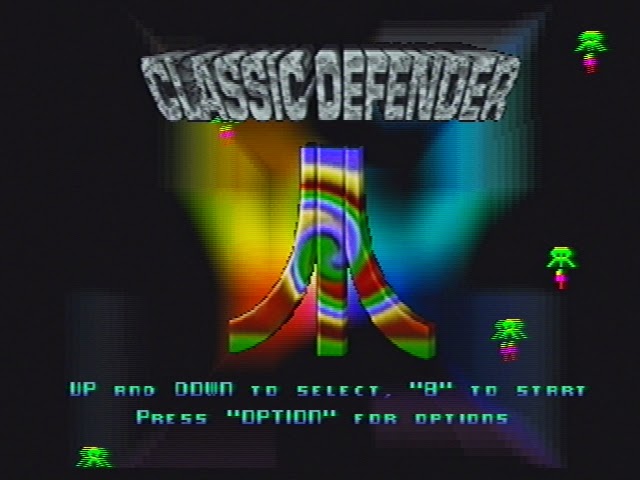
Jeff Minter is well known for his work on the Jaguar - indeed Tempest 2000 is widely regarded as the system's best game. Whether or not you agree with that is down to individual taste, but there is no denying Llamasoft's space shooter is a fantastic experience and still holds up today. What many people probably don't know however, is that Minter programmed another title for the Jag that is perhaps a little less well known: Defender 2000. As soon as you fire up the Defender cart, it's unmistakable as a Llamasoft game and even though there's no mention of the company name, the psychedelic swirling colour schemes, rotating bovine heads and spaced-out techno music are all recognisable hallmarks of the self-styled Yak's work.

As with Tempest 2000, Defender 2000 is a sort of homage to an earlier game. And just as with Tempest, you get several games on the cartridge - the original arcade version of Defender, a slight redux in Defender Plus, and the main event of this collection - Defender 2000. There's also a rather interesting bonus game in the form of Plasma Pong, which is meant to be an unlockable only accessible once you've beaten Defender 2000...but my cart came with it already unlocked so kudos to the previous owner who did the hard work for me. As the name suggests, Plasma Pong is basically the original Pong but with a nice vomit-inducing background of kaleidoscope colours and some updated bleeps and bloops. It's a fun aside and a nice bonus for completing the main game. Which is what we're really here to look at, so without further ado...

The premise of the Defender games is pretty simple - miners are working on the surface of an alien planet and it's up to you to keep them safe. I guess that's why it's called Defender then. You pilot a heavily armed spacecraft around, zapping alien nasties by travelling left and right across the alien landscape at terrific speed, all the while trying to keep the humans safe but also dodging alien attacks and utilising the map at the top of the screen to locate enemy units. The original Defender hit the arcades in 1981 and was a massive success for Williams, and playing this faithfully-recreated arcade port gives a clear indication as to why - the game is super-fast and hard as nails, but ultimately very enjoyable and a real test of skill: all ingredients that combine to make a great arcade experience. This Jaguar version is a recreation of the 1981 original and is every bit as playable today in 2014 as it probably was in 1981. I say 'probably,' because I was but a twinkle in my old man's eye in 1981, having being foisted onto an unsuspecting world the following year. I can only apologise.

The second iteration of Defender included on this cart is Defender Plus - essentially the same game as the original but with a few added graphical effects and a newly drawn spaceship for you to control. It's every bit as enjoyable as the first game but has the added bonus of psychedelic colours sequencing across the landscape and some nice sprite work for the aliens.

The final piece of the Defender 2000 package, funnily enough, is Defender 2000 - the updated and 'modernised' take on the original. I have to be honest here - I'm not a huge fan of the main event, and much prefer the other two games in this collection and the simple reason is that in Defender 2000 it is too easy to lose lives and see the 'Game Over' screen. This isn't because the game is just plain hard and I'm rubbish (both true, by the way), it's because the ship you pilot is far too large for the environment - dodging enemies and their projectiles is a nightmare because rather than piloting a sleek little fighter, you're now in control of what might as well be a Transit van with lasers bolted on. Defender 2000 does introduce some new features, such as the way the game now scrolls vertically as well as horizontally, and the re-drawn graphics and background images are pretty nice...but the mismatched size of the ship is a real problem here. If it had been of a similar size to the one in the original game, dodging projectiles and waving between aliens would have been a breeze. As it is, this one thing stops Defender 2000 being up there with the other iterations the cart. It's not a bad game by any stretch of the imagination, and the music and graphics are great (there is liberal use of the Jaguar's blitter in all three titles too), as is the inertia-based physics engine of the space craft...it just doesn't feel as nice to play.

That said, as an overall package Defender 2000 is great. You essentially get three games on one cart (four if you count Plasma Pong too) and while one of them is just 'OK,' two of them are outstanding arcade classics. As a side note, there is another Jaguar title in the same vein as Defender called Protector, which was an unfinished game that was completed by Songbird Productions in the early 2000s. I've not played it personally (although I've seen footage of it being played) I'm reliably informed that it is superior to Defender 2000. Might be worth checking that out too if you're into your retro space-shooters.